Most attorneys lose cases they thought they had won. Not because the evidence was weak, but because the twelve people in the box saw something entirely different from what the trial team saw. That gap is the reason law firms hire a jury consultant.
Dr. Melissa Pigott has spent 45 years measuring that gap. In this episode of the Trustcast Show, she sits down with Zane Myers to explain what a mock trial actually reveals, why jurors routinely ignore the exhibit notebook your team spent months assembling, and how a statistical juror profile changes what you do in voir dire.
What a jury consultant sees that attorneys cannot
Melissa is blunt about the biggest blind spot in litigation: advocacy itself. A trial team lives with a case for two or three years. By the time they walk into court, they cannot hear it the way a stranger hears it for the first time.
That is the entire point of jury research. A jury consultant is not there to tell you your case is good. They are there to show you what happens when people with no stake in the outcome, no legal training, and forty years of their own life experience are handed your evidence and asked to decide.
The most common reaction in the observation room is not agreement. It is shock.
What a mock trial actually looks like
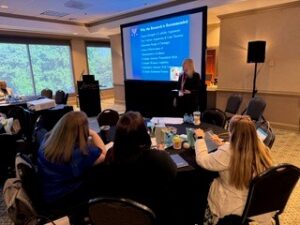
This is not a focus group around a conference table. A Magnus research day runs twelve to fifteen hours, with multiple jury groups running in parallel on the same case.
- Recruiting: jurors are drawn to match census data and venue demographics, so the panel reflects the county where the case will actually be tried.
- Presentation: both sides get argued, with real exhibits and real demonstratives.
- Instructions: jurors receive actual jury instructions, not a simplified summary.
- Deliberation: groups deliberate to a verdict on a real verdict form.
- Measurement: surveys capture individual reactions before and after deliberation, so you can see who moved and why.
Melissa’s preparation goes further than most people expect. To understand an airline crash case well enough to explain it to a mock jury, she learned to fly the aircraft in a simulator.
Why jurors ignore the evidence notebook
Here is the finding that gives the episode its title. Trial teams build meticulous exhibit notebooks. Mock juries frequently set them aside and decide on common sense instead.
Melissa’s explanation is rooted in her doctorate in social psychology and the study of group decision making. Jurors do not arrive as blank slates. They walk in with pre-existing attitudes and worldviews that function as a lens, and that lens filters everything that follows. Evidence gets interpreted through the worldview, not the other way around.
Deliberation is where this becomes visible. Coalitions form along lines nobody predicted. Arguments break out and occasionally have to be broken up. A juror seizes on one small detail that both trial teams considered irrelevant and carries the room with it. And the foreperson is almost never the person the attorneys expected. Sometimes they get the job because they happened to sit at the head of the table.
Pre-existing beliefs matter more than the evidence. A good juror who genuinely wants to be fair still cannot change their own worldview between opening and closing.
Voir dire when a jury consultant builds the profile
If worldview drives the verdict, then jury selection is the highest leverage moment in the trial. Melissa builds a statistical profile before voir dire begins, drawn from prior research in the same venue and case type, sorting prospective jurors into four categories rather than a simple keep or strike.
Two procedural points from the episode that trial teams should note:
- Back strikes are available in state court in many jurisdictions but not in federal court, which changes how aggressively you can commit early in the panel.
- Checking a juror’s social media during trial will get you held in contempt in front of some federal judges. Know the jurisdiction before anyone on your team opens a browser.
When law firms should bring in a jury consultant
The ideal window is before discovery closes. Waiting costs you the ability to act on what the research finds, because by then the record is fixed and the strategy is locked.
The bigger shift Melissa describes is in why firms hire at all. Almost no cases go to trial anymore, so most Magnus clients now commission research ahead of mediation rather than ahead of trial. A defensible number from a mock jury is leverage at the mediation table. It also solves a specific problem: the insurance adjuster who arrives in the morning insisting the case is worth nothing, watches a jury deliberate, and revises their position before lunch.
The clearest illustration is the Exxon dealers litigation. Plaintiff’s counsel lost at trial, brought Magnus in to rebuild the case from the ground up, and won 1.2 billion dollars at retrial.
If your firm has never worked with a consultant, Magnus has written a primer on what to expect the first time, and the case experience page shows the range of matters they have handled.
About Dr. Melissa Pigott
Dr. Melissa Pigott is co-founder of Magnus Research Consultants, a trial consulting firm she has led since 1993. She holds a PhD in social psychology from Florida State University, where she began studying eyewitness identification in 1980 under research that later helped inspire the Innocence Project. Her early finding still shapes her work: eyewitnesses are usually believed and frequently wrong.
Magnus is based in Florida and works cases nationwide. You can reach the team through the contact page or read more about the partners. More on Melissa’s background is available at magnusresearch.com.
Episode chapters
- 00:00 Introduction to Dr. Melissa Pigott
- 00:57 The strangest thing a mock juror ever said, and the plaintiff’s lawyer who settled over a tie
- 01:26 Studying eyewitness identification at FSU in 1980, and why eyewitnesses are usually believed but often wrong
- 02:15 The attorney who has tried hundreds of cases and never needed a consultant, and what Melissa tells them
- 03:08 A PhD in the psychology of group decision making, and how it differs from what lawyers know
- 03:51 When to bring in a jury consultant, and the real cost of waiting too long
- 04:45 The Exxon dealers case: losing at trial, rebuilding, and winning 1.2 billion at retrial
- 06:15 Is a mock trial worth doing before mediation
- 07:22 What a mock trial actually looks like start to finish
- 09:06 Plaintiff work versus defense work, and how the mix has shifted over 45 years
- 10:10 How mock jurors are recruited using census data and venue demographics
- 12:11 The one thing a mock trial reveals that attorneys cannot get anywhere else
- 13:15 The insurance adjuster who changes their mind by lunch
- 14:11 Do mock jurors actually deliberate, and yes they sometimes fight
- 15:21 Where the gems get uncovered: coalitions, unexpected forepersons, deliberation dynamics
- 16:10 Pre-existing worldviews as a lens
- 17:55 Voir dire, building a profile, and the four categories of jurors
- 19:30 Back strikes in state court versus federal court
- 21:01 Why even good jurors cannot change their worldview
Frequently asked questions
What does a jury consultant actually do for a law firm?
A jury consultant designs and runs research that shows how real people respond to your case. That includes mock trials, focus groups, venue attitude surveys, witness preparation, and building juror profiles used during voir dire. The output is a measured read on case strengths and weaknesses from the perspective of the people who will decide it.
How long does a mock trial take?
A full research day typically runs twelve to fifteen hours and can involve multiple jury panels deliberating the same case in parallel.
Is a mock trial worth it if the case will settle at mediation?
Yes, and that is now the more common reason firms commission one. Very few cases reach trial. Research findings give you a defensible valuation to bring to mediation and often move an adjuster or opposing counsel who has anchored on a number.
When in a case should a firm hire a jury consultant?
Before discovery closes is ideal. Engaging earlier means the findings can still shape depositions, expert selection, and strategy while the record is open.
Work with Magnus
Magnus Research Consultants has been advising trial teams nationwide since 1993. If you have a case heading toward mediation or trial and want to know how a jury will actually receive it, get in touch with Magnus or browse the full list of jury research services.